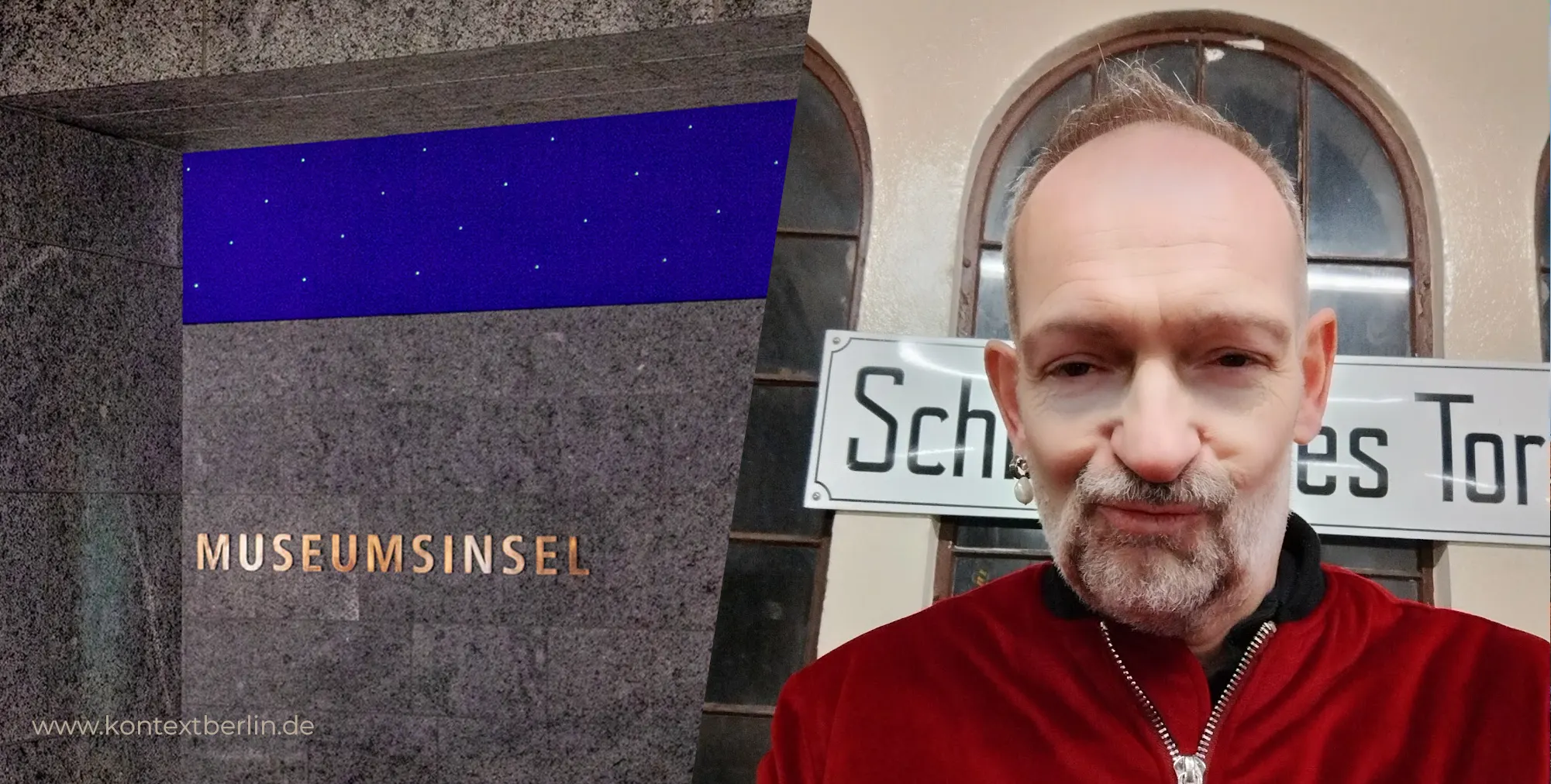

The Sky Beneath Unter den Linden – and Above Kreuzberg
Berlin is constantly changing – most visibly where history, architecture, and everyday life intersect. This blog post takes you on a personal journey along the new U5 line, from the historic center beneath Unter den Linden to the lively elevated station Schlesisches Tor in Kreuzberg. A look at construction sites, subway stations, urban history, and the small details that are so often overlooked in daily life.
Construction Sites, Patience, and Hope for What Comes After
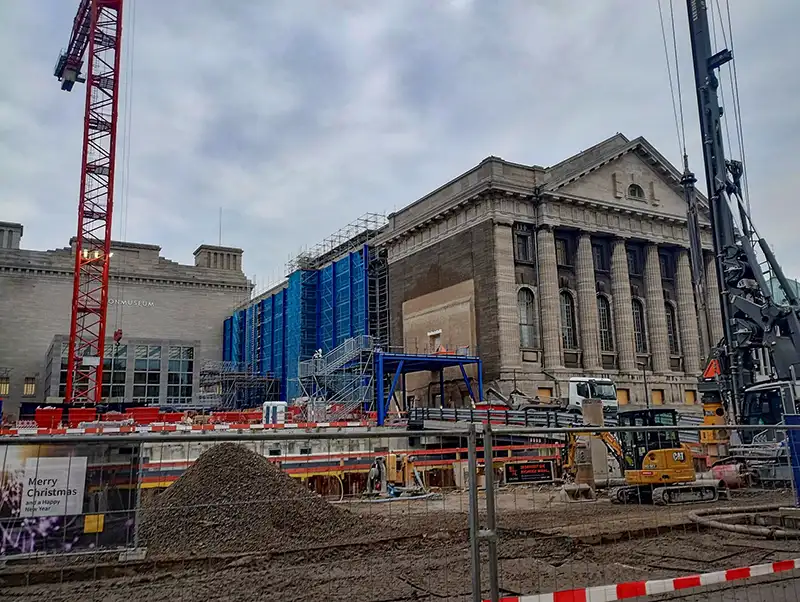
“And here we see the most beautiful square in Berlin – some even say in Europe – but unfortunately
not at the moment!” For a long time, this was how tours introduced the Gendarmenmarkt, while fences
and scaffolding dominated the view. For a while, the construction site could even be observed from
a specially built viewing tower.
Unter den Linden and the New U5 Line
What gives me hope is the experience that even long-term construction sites eventually disappear
– and that the waiting often turns out to have been worth it. One such place for me is Unter den
Linden, and there the extension of the U5 line, which runs largely beneath the boulevard from
Alexanderplatz to the main railway station.
The route reads like a list of Berlin landmarks: Rotes Rathaus, Museumsinsel, Unter den Linden,
Brandenburger Tor, Bundestag, and on to the Hauptbahnhof.
With this extension, the U5 has become a line over 22 km long, directly connecting its eastern
terminus in Hönow with the main station. For eastern Berlin, it’s fantastic to be able to reach
the Hauptbahnhof directly; for the main station, it means direct access to the subway network;
and for Museum Island, it marks the very first subway station on the island.
Subway Stations as Underrated Urban Spaces
Subway stations are places we usually rush through in everyday life, barely noticing many of
their details. Yet in many stations, there are striking – and more subtle – elements that often
reflect the history of the surrounding neighborhood. It is well worth pausing for a moment to
take a closer look.
As a Berlin resident, one probably uses these new U5 stations rather rarely. I, however, am there
very often and even include some of the stations in my tours! They are all modern, well
maintained, free of advertising, and each station has its own individual design.
Brandenburg Gate: History on the Platform
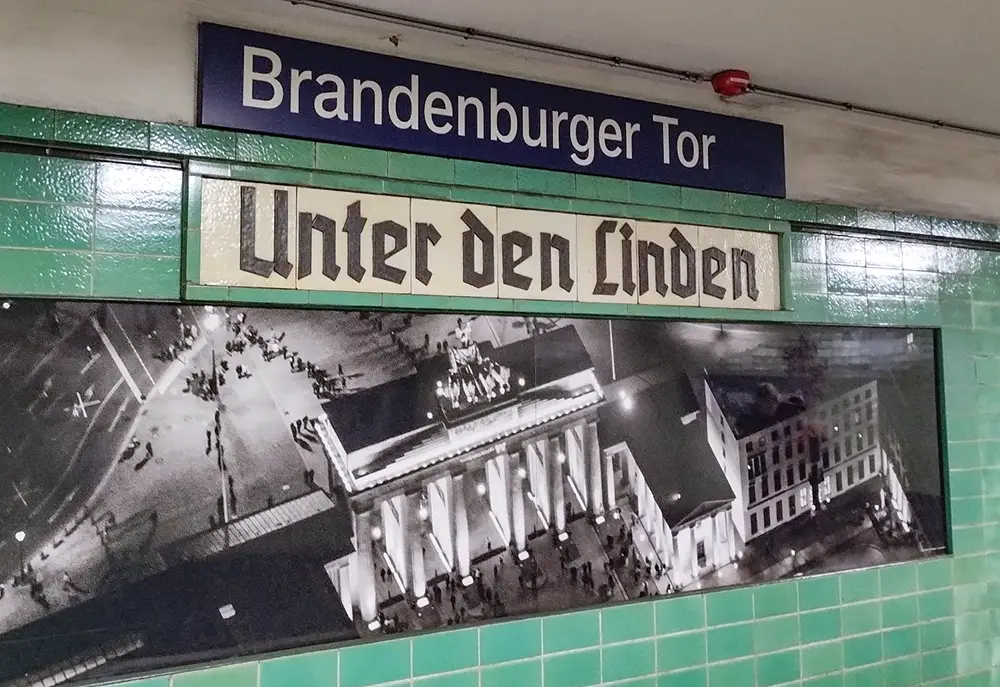
Capital city history – on the way through.
Before the U5 was extended here, there was only an underground S-Bahn station called Unter den Linden
at this location. With the expansion and its new role as an interchange station, it was renamed
Brandenburger Tor, as the newly built station one stop further on is now called Unter den Linden.
Unter den Linden: Science, Sound, and the Anthropocene
At the new Unter den Linden subway station, one encounters a very different exhibition. This is
also where you exit for the main building of Humboldt University, housed since its postwar
reconstruction in the Prinz Heinrich Palace. The New State Library is also just nearby.
In this “station of science,” there is an exhibition on the Anthropocene, the geological age of
humankind. The graphics and texts are even displayed in proper glass cases, allowing for a
relatively easy change of exhibitions.
And that’s not all: one is often enveloped here by the sound of classical music. This is a pilot
project in cooperation with Klassik Radio called “Klangvoll im Untergrund” (“Soundful
Underground”). I’m a fan – unfortunately I haven’t heard the music in recent months and very
much hope that this does not mark the end of the project.
Unter den Linden station was also planned and built as an interchange station with the U6 line.
As a result, it features a much more generous hall connecting the different levels. By the way:
the nearby Französische Straße station is no longer in use and has become a ghost station.
Museumsinsel: Schinkel Beneath the Stars
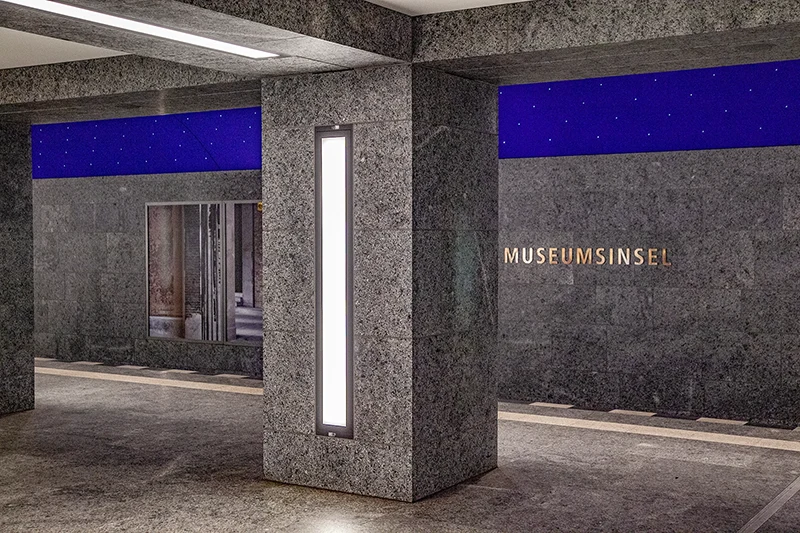
More information about the tour
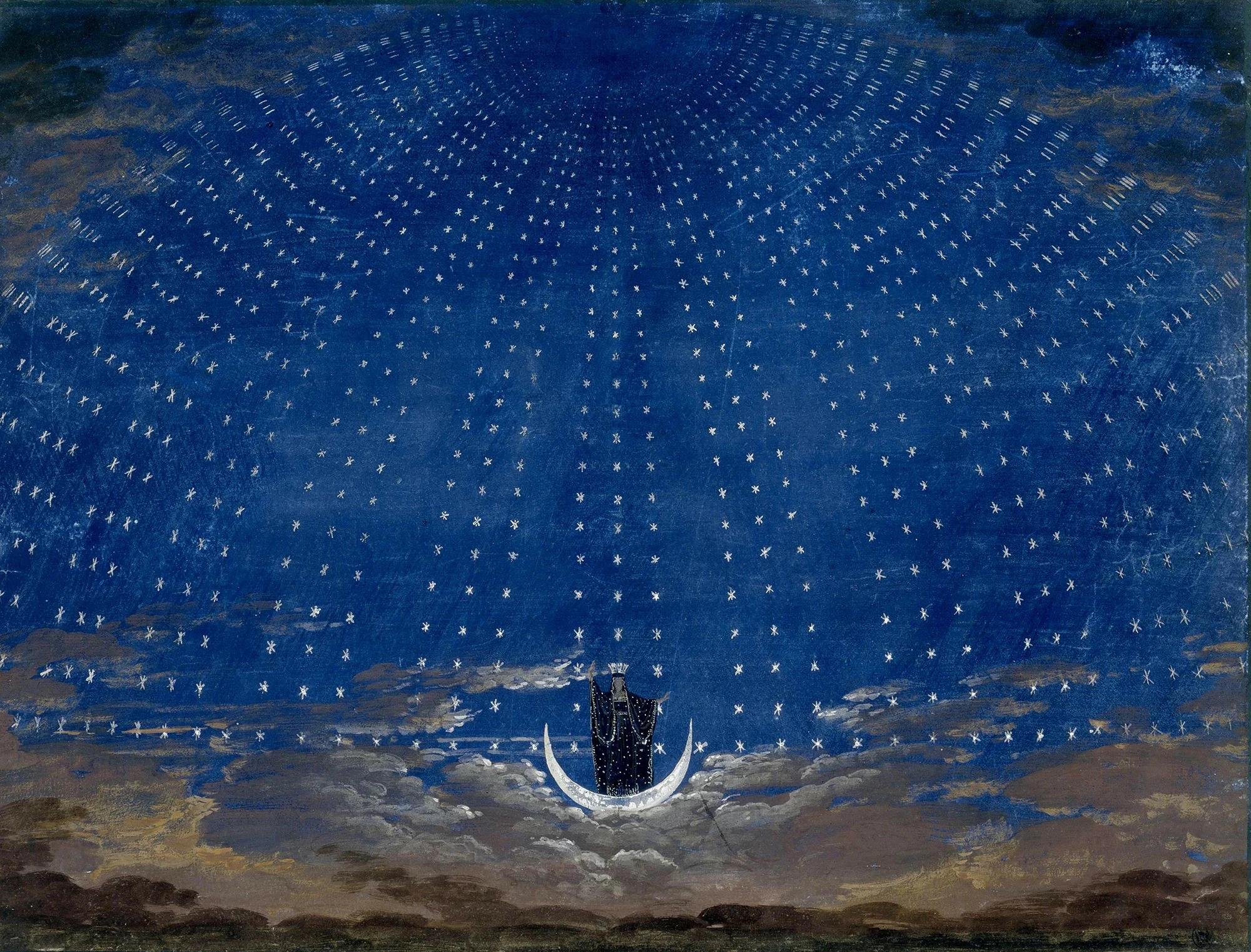
A versatile artist, Schinkel also painted and designed stage sets. One particularly famous drawing
is his design for a stage set for the Queen of the Night in Mozart’s The Magic Flute. This
image inspired the deep blue, star-filled sky above the tracks. It also connects the station to its
surroundings, as this is the stop for visiting the nearby Staatsoper Unter den Linden.
The rich blue harmonizes with the gray of the granite. There is no advertising here either. Instead,
pairs of large-format photographs show details of nearby Schinkel buildings – details whose historic
forms, combined with the traces of time, create a striking contrast to the pristine modernity of the
subway station. To me, it almost feels like an architectural memento mori: what was new
becomes old. The passage of time is relentless…
Beyond that, the photographs also reflect Schinkel’s method of telling stories about a building’s
purpose through reliefs and paintings. I am genuinely delighted!
Back to Kreuzberg: The Sky Above Schlesisches Tor
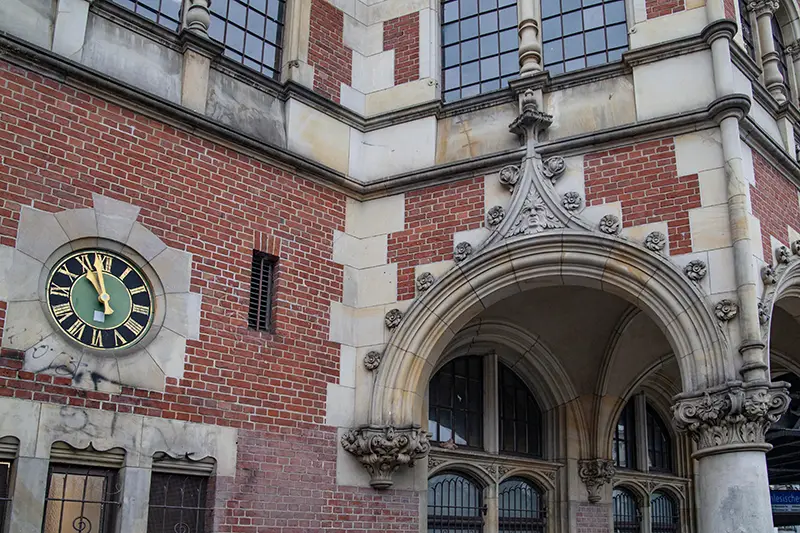
The imposing Wilhelminian-era building presents itself in Kreuzberg’s characteristically faded
grandeur. A closer look reveals the proud architectural ambition of its time. Completed some 120
years before the new U5 stations, Schlesisches Tor once housed a restaurant, cafés, and shops – a
station conceived as an urban meeting place.
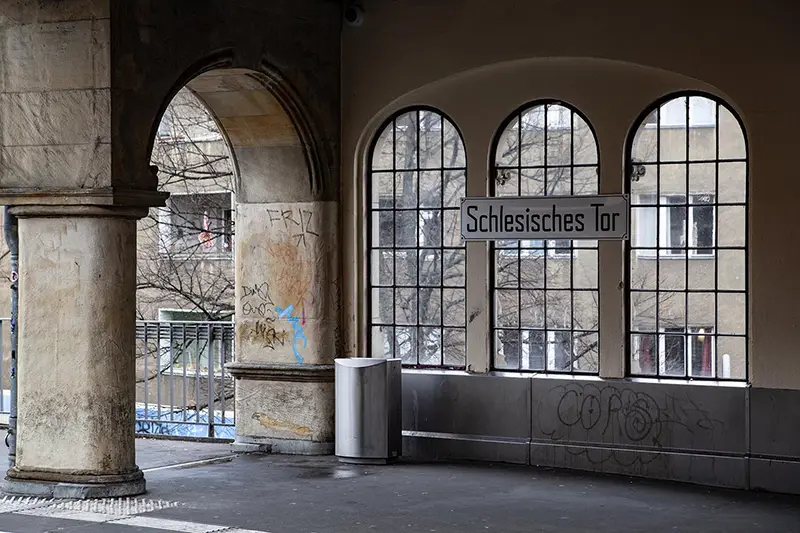
One finds oneself in a completely different, vibrant Berlin universe full of contrasts: newcomers
and long-time residents, hipsters and the homeless, commuters, addicts, international partygoers.
The sky above Kreuzberg.
Image 3: K. F. Schinkel: W. A. Mozart »Die Zauberflöte«, Entwurf zur Sternenhalle im Palast der Königin der Nacht, 1815, Gouache; 46,4 x 61,5 cm, Staatliche Museen zu Berlin, Kupferstichkabinett


