

The Oberbaum Bridge in Berlin
There are quite a few surprising statistics about Berlin. One of them is that Berlin has more bridges than Venice! Who would have thought? In fact, that isn’t quite as impressive as it sounds—Hamburg has even more… and in the end, it also depends on the overall size and area of a city. I personally consider myself very lucky to live close to the impressive Oberbaum Bridge, which spans the River Spree and connects the neighbourhoods of Friedrichshain and Kreuzberg. It is often described as the most beautiful bridge in Berlin, and indeed it is a unique and remarkable structure—and one of the city’s best-known landmarks.
The Origin of the Name
I cross the bridge regularly on foot or by train, and I often talk about its history on my neighbourhood tours. This usually starts with the origin of its name. From the 18th century until the mid-19th century, Berlin was surrounded by a customs wall, known as the excise wall (Akzisemauer). At its gates, goods entering the city were taxed. Where this tax border crossed the River Spree, shipping traffic was naturally halted as well. The river was narrowed by wooden piers from both banks, and the center passage could be blocked with a floating log reinforced with iron spikes. The entire installation was known as the “Baum.” There was an “Oberbaum,” where the river flowed into the city, and an “Unterbaum,” where it flowed out. The Unterbaum was last located near today’s government district, close to the Reichstag building. The nearby Unterbaumstraße still commemorates this period. The only surviving gate of the excise wall today is the Brandenburg Gate.
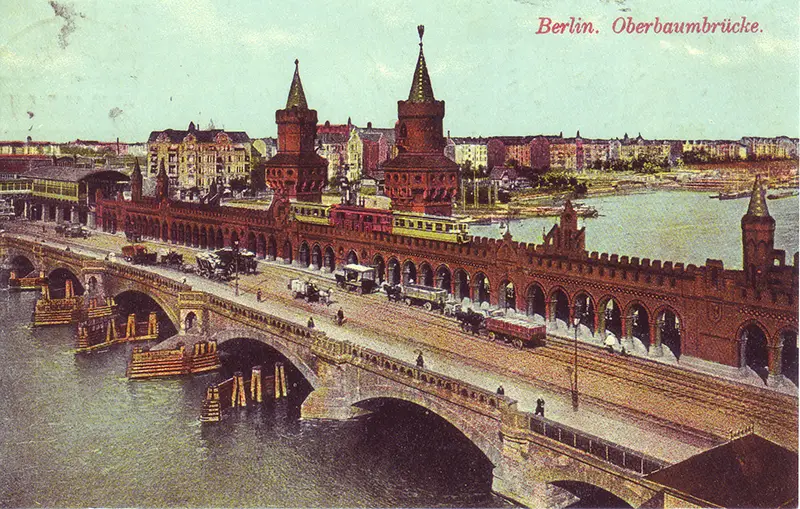
The customs wall had already been dismantled for about thirty years when the present-day Oberbaum Bridge was completed in 1896, after two years of construction. For reference: the Brandenburg Gate—incidentally the only surviving gate of the excise wall—was at that time only just under 110 years old.
Architecture & Historicism
Contemporary with the Oberbaum Bridge was, for example, the Reichstag building, which had been completed just two years earlier. Construction of today’s Berlin Cathedral had been underway for two years, and work on what is now the Bode Museum began two years later. These buildings were erected in the architectural style of the era—Historicism—which drew on stylistic elements from earlier periods. The same applies to the Oberbaum Bridge, whose Neo-Gothic design references medieval architecture.

The bridge’s two medieval-looking towers form an imposing city gate, referencing the former gate function of the Oberbaum. One tower is crowned with the Berlin Bear, the other with the Brandenburg Eagle. Historicism is the architectural style of the industrial age. Despite its stylistic look back, the bridge was a thoroughly modern structure: an elegant solution combining elevated railway tracks, a roadway, and a pedestrian walkway within a single construction. Beneath the railway tracks runs a covered footpath designed like a medieval cloister—modern technology wrapped in medieval form.
Berlin’s First Elevated Railway
The railway itself went into operation in 1902 and was Berlin’s first elevated line. Its inaugural route ran from what was then Stralauer Tor (today Warschauer Straße) to Potsdamer Platz—passing stations such as Schlesisches Tor, Kottbusser Tor, and Hallesches Tor. Much of the line was built along the still-existing corridor of the dismantled customs wall, and these stations mark the former locations of the wall’s gates.

The stories surrounding the Oberbaum Bridge are as numerous and eventful as the history of the city itself. The structure was badly damaged during World War II, but its massive piers prevented a complete collapse. During the period of the partition, it stood without its towers as a pedestrian border crossing between East and West Berlin. Before the Berlin Wall was built and Berliners could easily cross, the Kreuzberg side featured exchange offices and shops selling goods that were scarce in the East. Where the music venue “Lido” stands today, there was once a cinema where visitors from East Berlin could watch American films.

After the construction of the Wall in 1961, a strictly controlled border crossing remained. A guard tower stood in the middle of the bridge, the railway line was severed, and Schlesisches Tor became a terminus station. Cut off by the Wall, this part of Kreuzberg turned into a neglected area, one of those that were often referred to as the “end of the world.”
Ironically, it was precisely this border location that helped shape Kreuzberg into such a distinctive part of West Berlin. The district had—and still has—a large stock of classic pre-war Berlin tenement buildings. Because of their immediate proximity to the Wall, however, the area was considered undesirable. This attracted tenants who were willing to live here for the consequently cheap rents. Low rents meant little investment and almost no modernisation, and the neighbourhood remained a run-down district of faded grandeur.
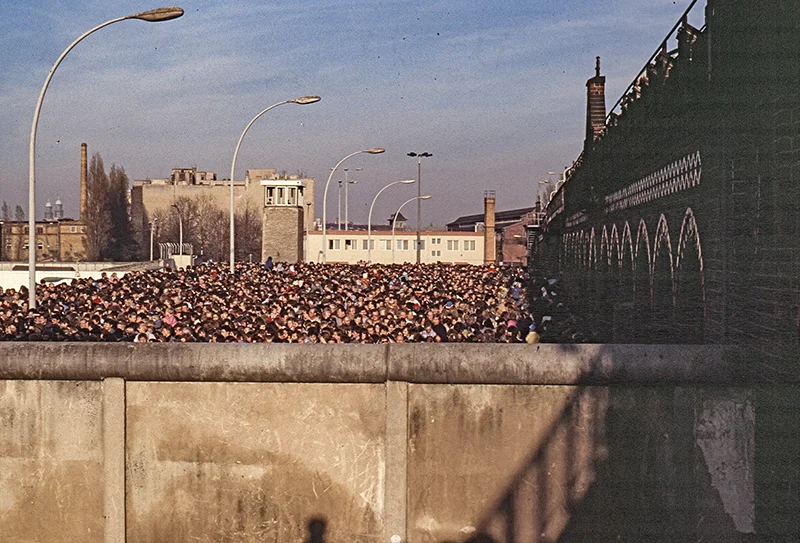
When the border opened in November 1989 and many thousands of East Berliners crossed the bridge, their first impression of West Berlin was this grey, dilapidated quarter. It must have come as a profound disappointment—far removed from the glittering expectations of “the West.”
Restoration & Present-Day Significance
Today, the bridge has been beautifully restored. It features a modern central section made of a steel arch and is not only the heraldic emblem of the Friedrichshain-Kreuzberg district, but also a Berlin landmark that appears in millions of photos, graphics, and films. Riding the U-Bahn across the bridge is an experience in itself: the Spree is particularly wide here, and the elevated tracks offer sweeping views of the water and the modern city—both toward the city center and toward Treptow and Stralau, with the “Molecule Man” sculpture in the distance.
Crossing the bridge on foot brings you much closer to the landmark. You can choose between the sidewalk alongside the road for car traffic and the “cloister” beneath the tracks. I love the cloister—but I sometimes avoid it, depending on the season. Here, the smell of urine often mixes with wafts of weed and perfume from the EasyJet crowd and other tourists. In the early hours of weekend nights, there is often a line of good-humored partygoers winding past homeless encampments halfway across the bridge, heading for the well-known club “Watergate,” which unfortunately closed at the end of 2024—another sign of the city’s ongoing transformation. The masonry of this historic, listed structure is completely covered in graffiti. Looking toward the city center, you face the painfully bland sight of several “Media Spree” buildings along the Mühlenstraße in Friedrichshain, some of them behind the East Side Gallery. Hovering above this architectural dullness is, for me, above all one word: “investment.” Even Gründerzeit architecture was driven by investors—and yet, despite its historical references, that style was bold, energetic, and confident in the future it sought to build. This built-in contradiction is something the bridge still represents for me today.
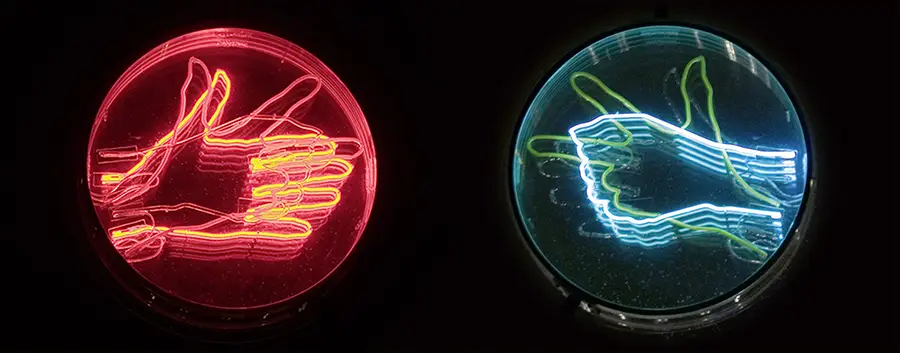
Embedded within the steel beams of the modern central section is a modest yet remarkable work of art that today stands for much more than the former East–West divide. The frequently overlooked artwork “Rock, Paper, Scissors” by Thorsten Goldberg uses neon tubes at night to stage an endless game of opposites as a gamble: paper beats rock, rock beats scissors, scissors beats paper—East, West, commerce, living space, displacement, reconstruction, vandalism, monument protection, homelessness, wealth, hipsters, stench of urine, perfume clouds, past, present, future, Unterfriedrichshain, East Kreuzberg: Berlin, in a nutshell.
Kreuzberg is my home neighbourhood—I consider myself lucky to live in this incredible part of Berlin. Right on my doorstep, these tours begin, offering you the chance to discover much more about the area:
Kreuzberg: Myth and Reality – Kreuzberg Tour
The East Side Gallery – Berlin Street Art Tour


