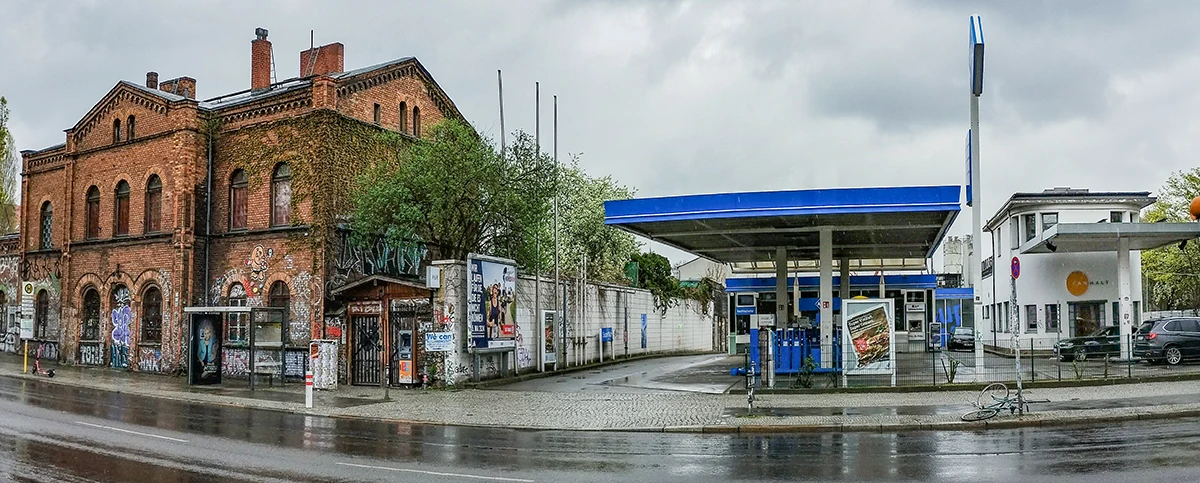

Hidden Berlin: Lohmühleninsel in Kreuzberg – Off the Beaten Path Berlin
I’m a Kreuzberg local by choice, and I love it here. This neighborhood is truly vibrant, full of character and history. Kreuzberg is well-known even outside Berlin, which means there’s high interest in Berlin city walks. My guests are often both Berliners from other districts and visitors from all over Germany – not to mention international travelers curious about off the beaten path Berlin.
I find it amusing that some visitors think the streets are surprisingly clean, while others find them a bit messy. It really depends on where you come from, what you’re used to, and which part of Kreuzberg you’re exploring. Almost everyone, however, is struck by the pervasive presence of graffiti.
With my keen eye for visuals, this is one aspect of Kreuzberg that I notice deeply. Certain images and slogans have stuck with me, like “Bonjour Tristesse” on the gray corner building at Falkensteinstraße – Schlesische Straße. The phrase dates back to when the original scaffolding was still in place! During Berlin’s division, visitors crossing the Oberbaumbrücke would have seen this as an unusual welcome to Kreuzberg. Sadly, most graffiti feels more like random scribbles – especially on historic buildings.
One historic building here is the former customs house, also called the excise house, on Lohmühleninsel. This hidden island is easy to overlook in daily life. It sits at the upper lock of the Landwehr Canal, where the canal branches off from the Spree. The canal was artificially constructed between 1845 and 1850 to handle the growing industrial traffic and to relieve the Spree. Back then, it ran entirely outside the city gates.

The parallel flood channel already existed and was called the Schaf- or Floßgraben. Until 1803, three bark mills stood along this channel, processing oak and spruce bark – known as lohe – into powder for leather tanning. This is where the island gets its name.
The customs house – officially the “Tax House of the Royal Water Inspection” – was built in 1859/60. It collected duties on goods entering the city via the waterway. However, it served as a customs office only briefly: the excise border was abolished in 1877. In 1895, it was converted into housing for the staff of the neighboring upper lock. Around the same time, the Schlesische Brücke and Obere Freiarchenbrücke were built. Today, both are listed monuments, forming an ensemble with the former customs house of small, understated historic buildings.
Right next to it is another historic building, often overlooked because of its proximity to a modern gas station: a petrol station building from 1928/29. It’s the oldest preserved gas station in Berlin and the first in the city to combine fuel with a rest stop for drivers.
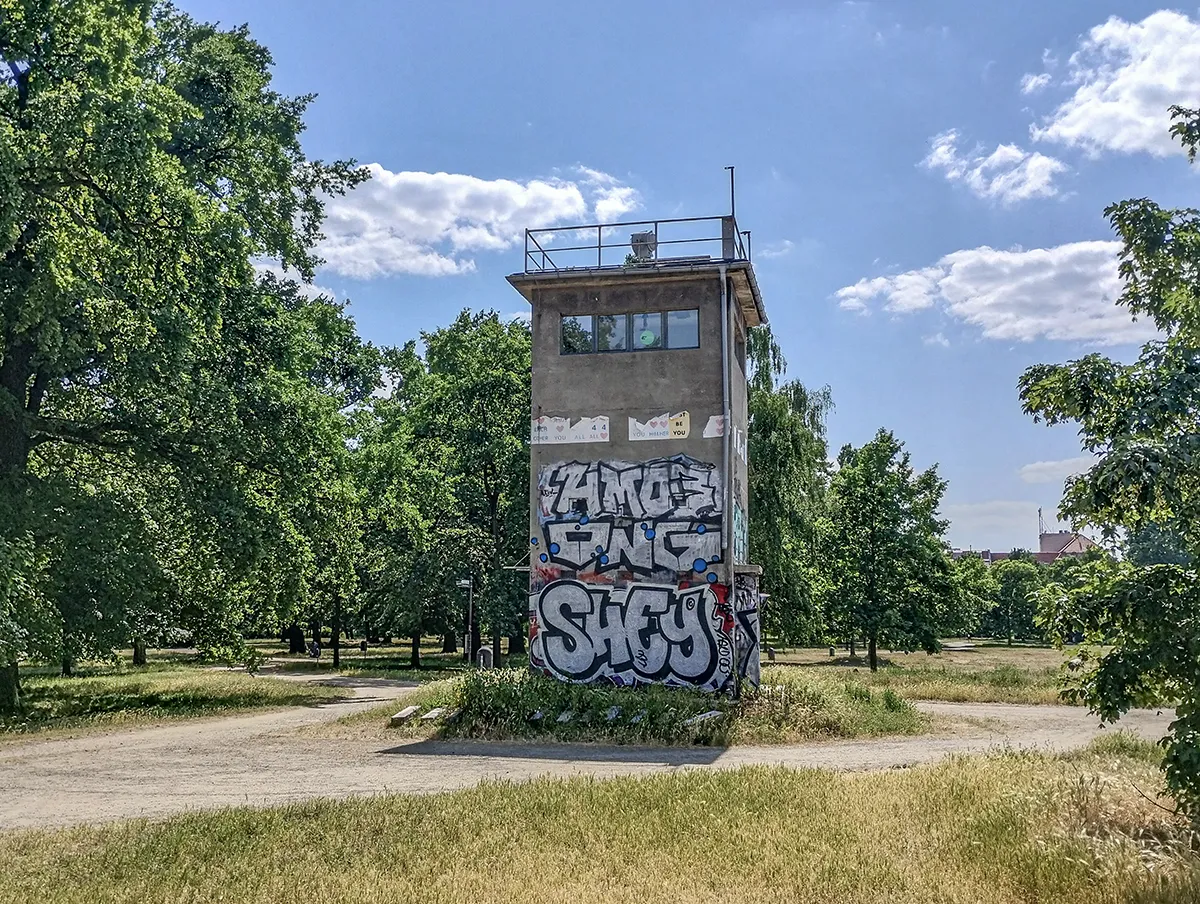
Heading out of the island towards the city, you cross the flood channel via Obere Freiarchenbrücke, moving from Kreuzberg into Alt-Treptow. Here stands a single remaining segment of the Berlin Wall, and a little further along, another historic building: a preserved DDR border watchtower, sadly often covered in graffiti. During the division, this marked the border between East and West Berlin, between Kreuzberg and Alt-Treptow. The street ended abruptly at the wall – the Lohmühleninsel lay on the Kreuzberg side of the inner-German border.
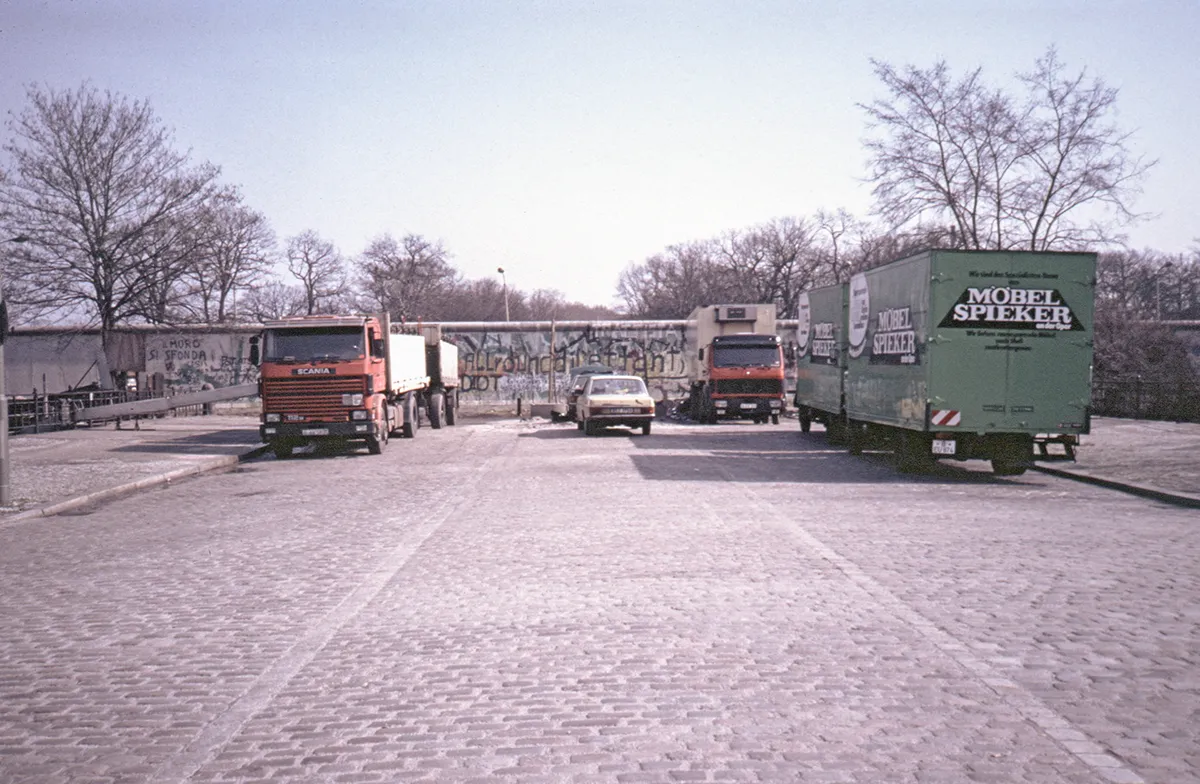
Positioned between the Spree and Alt-Treptow, the island forms an outer “corner” of Kreuzberg and the eastern edge of the former postal district SO36. This area stretched eastward in a rectangular shape and was surrounded on three sides by the Berlin Wall. Much historic architecture survived here. During West Berlin’s division, few wanted to live in such a border area – the Wall was not a view anyone wished to have daily.
Where the Wall is seen in the 1987 photo, today a double row of cobblestones marks its path – freely walkable. Visitors can discover a part of Berlin that feels like the outskirts despite its central location and has largely escaped gentrification.
Along the flood channel, there are small clubs, beer gardens, and restaurants. A slice of hidden Berlin that doesn’t seek attention but is especially worth visiting in summer.


