

A Biedermeier World Wonder: Berlin’s “Soup Bowl”
I think all tour guides know this: locals often know less about the details and history of their own city than visitors – and certainly less than tour guides. As a Berlin tour guide, I have therefore made it a personal challenge to convince Berliners – those who actually live here – to take part in tours in their own city. I have found that food tours often attract local guests who might not otherwise join a tour in Berlin.
One particularly fascinating Berlin artwork that many residents know surprisingly little about is the unique Granite Bowl in the Lustgarten in front of the grand staircase of the Altes Museum. Berlin’s characteristic sense of humor gave this artwork – once referred to as a “Biedermeier world wonder” – a lovingly irreverent nickname: the Soup Bowl.
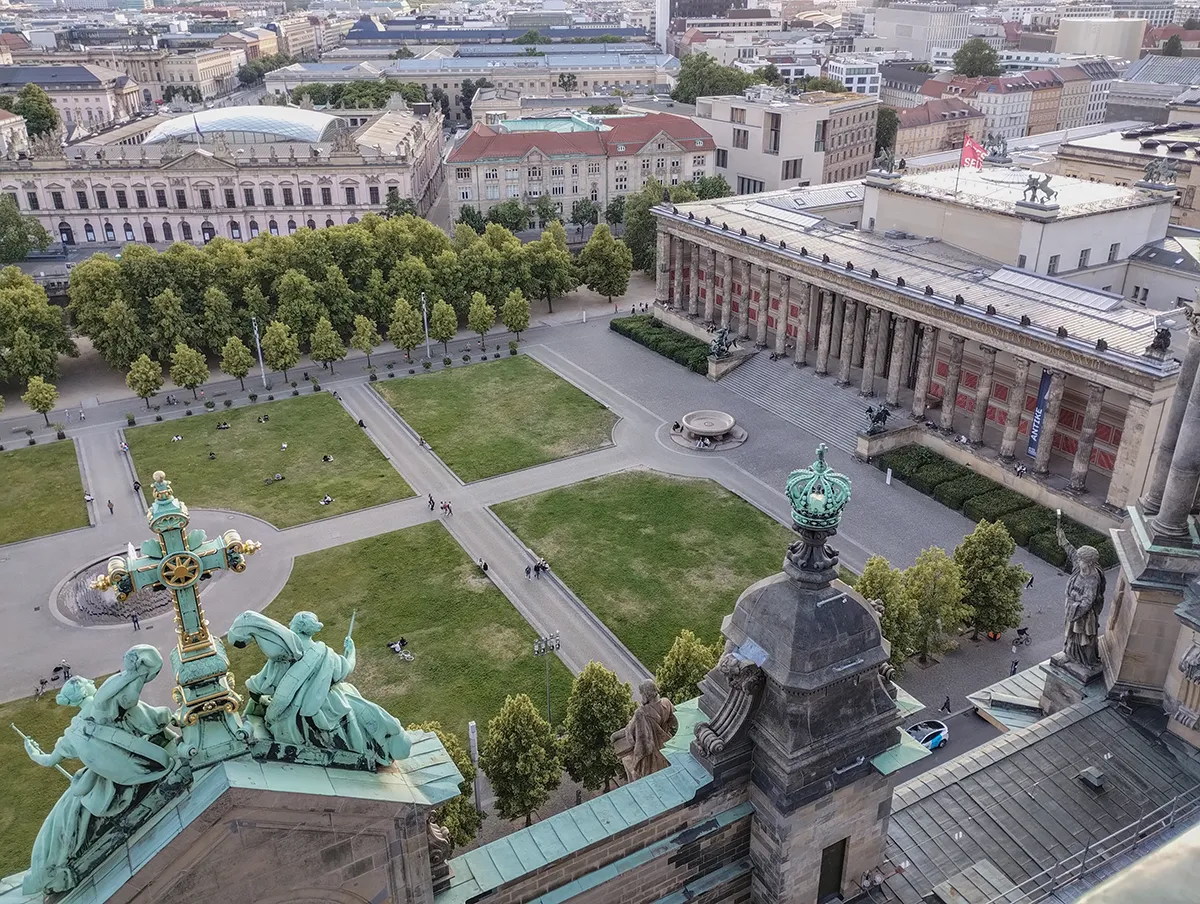
Berlin is a city with an extraordinarily eventful history, and the Soup Bowl is a perfect object through which to tell parts of that story. It was in fact created as a showpiece, and its origin story speaks first and foremost of the desire for representation: more impressive! bigger!
The history of the bowl is closely intertwined with the history of its location. It was commissioned in 1826 by King Frederick William III after he learned that the English envoy to Prussia had ordered a similar bowl from the court stonemason Christian Gottlob Cantian. Naturally, the king wanted a bowl that would surpass the one destined for England in size and magnificence. Cantian promised not only that, but even a masterpiece that would outshine the famous red porphyry bowl from Nero’s Golden House, displayed in the Rotunda of the Vatican. Not a modest ambition!
This ancient bowl of porphyry marble and its display in the Vatican clearly inspired the king’s architect, Karl Friedrich Schinkel. He planned to place the newly commissioned Granite Bowl in the rotunda of the “Royal Museum” he had designed – the building we now call the Altes Museum. It was the first museum building in Germany created with the purpose of making an art collection accessible to the public – outside the private palaces of the king and the nobility.
At the same time as constructing the new museum, Schinkel was also heavily involved in redesigning the Lustgarten. He designed a fountain for the center of the square, whose water pressure was supplied by a water tank located on the museum’s roof. In addition, Schinkel redesigned the cathedral of the time in a classical style to better integrate it, together with the new museum building, into the overall classical ensemble around the Lustgarten.
Back to the Granite Bowl: when the king received the news that the selected granite boulder would allow the bowl to be made even larger than originally planned, his response was, of course, to make it as large as possible. He and Prussia would thus possess the largest granite bowl in the world. And it still holds that record today: the largest bowl in the world carved from a single stone. It has a diameter of almost seven meters, a circumference of nearly 22 meters and weighs 75 tons.
However, at that size the bowl would have overwhelmed the proportions of the rotunda’s interior, and it was therefore decided to place it in the Lustgarten in front of the museum. That is where it stands today – or rather, stands again. The National Socialists leveled and paved the Lustgarten to use it for propaganda spectacles. The bowl’s central position interfered with their plans, so it was moved behind the museum. Slightly damaged by shrapnel during the war, it remained stored near the cathedral for a long time. In 1981, on the occasion of Schinkel’s 200th birthday, it was returned to its original location.
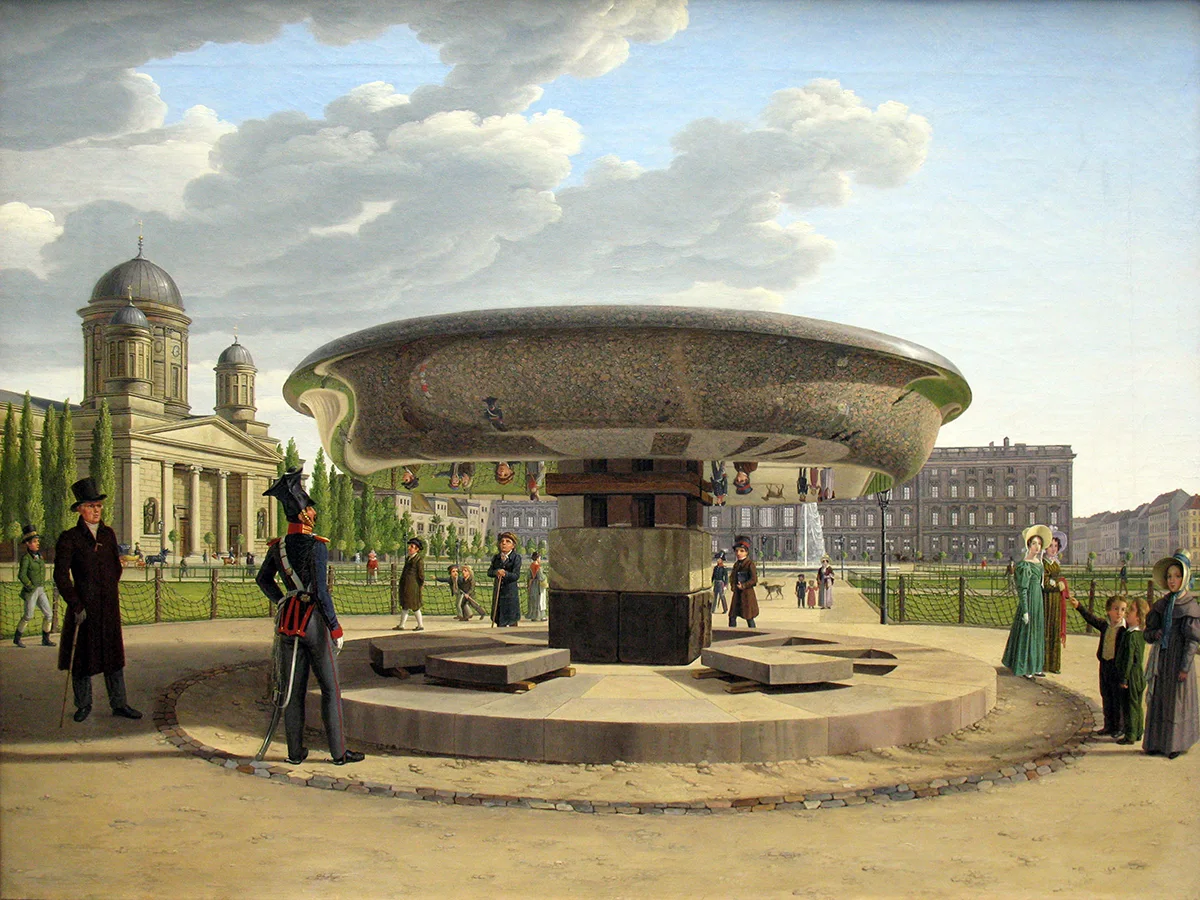
In contrast to today’s relative lack of awareness, there was enormous public interest at every stage of the bowl’s creation: from the king’s commission, to the extraction of the granite boulder, its transport, the two-year polishing process powered by a steam engine in a specially constructed building, and finally its installation. The museum opened in 1830; the bowl was provisionally installed in 1831, and the painter Johann Erdmann Hummel captured this moment in a highly detailed painting. In the image shown here, the bowl can be seen in a slightly elevated position. One can observe how mirror-smooth it once was. The precisely rendered reflections of the onlookers pay tribute to the technical marvel the bowl represented. After nearly 200 years outdoors, this shine has faded.
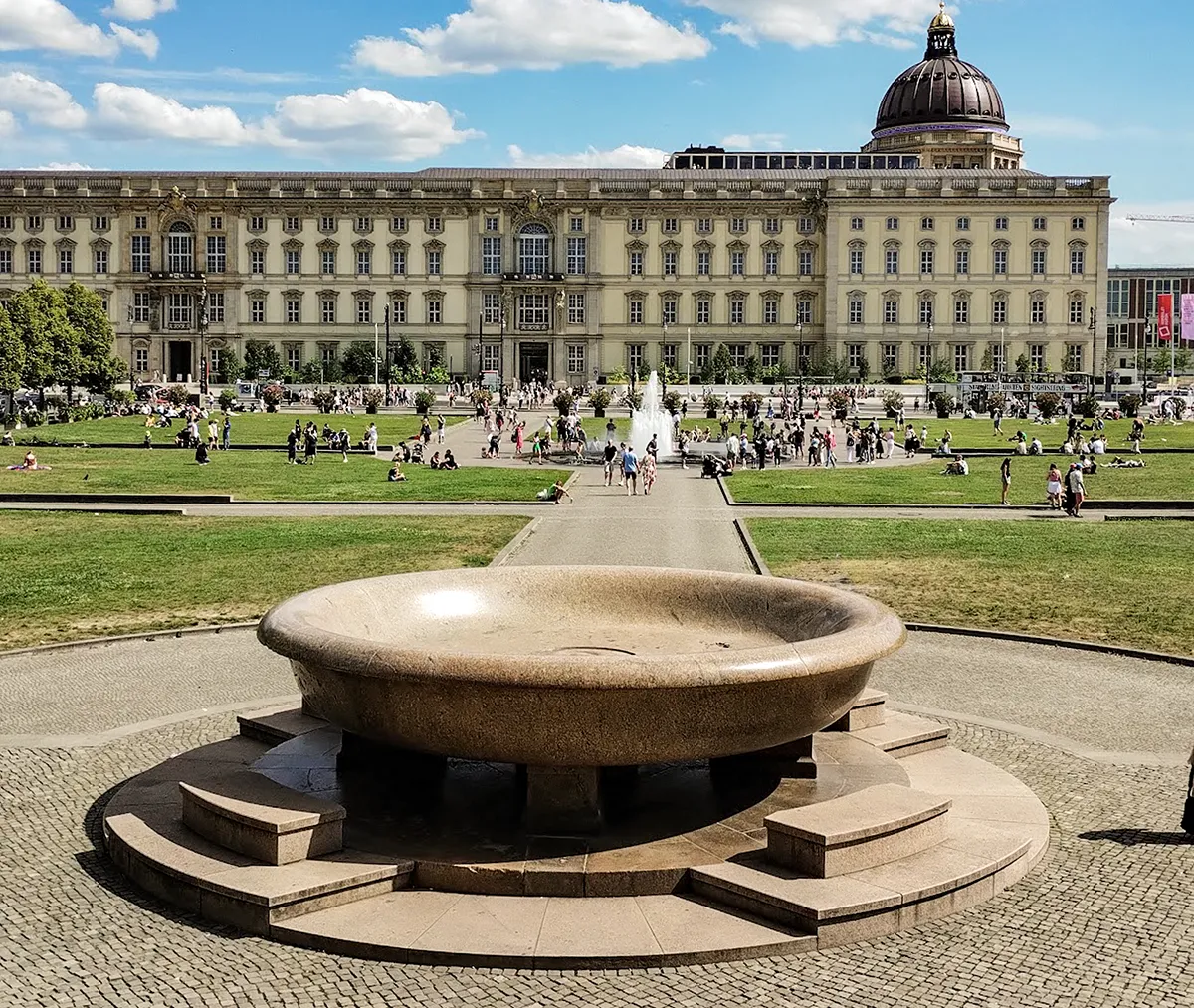
It is also interesting to note that the baroque palace in the background of Hummel’s painting does not yet feature the magnificent dome with the golden cross – today reconstructed as part of the Humboldt Forum. This dome was commissioned by the subsequent king, Frederick William IV, ensuring that the palace became the tallest structure in the city skyline at the time. On the left side of the painting we still see the old cathedral redesigned in neoclassical style by Schinkel. Today, the imposing Berlin Cathedral completed in 1904 stands there. Its dome remains one of the largest in the world. Berliners nicknamed the new structure the “Soul Gasometer” and its patron, Emperor Wilhelm II, the “Advertising Emperor.”
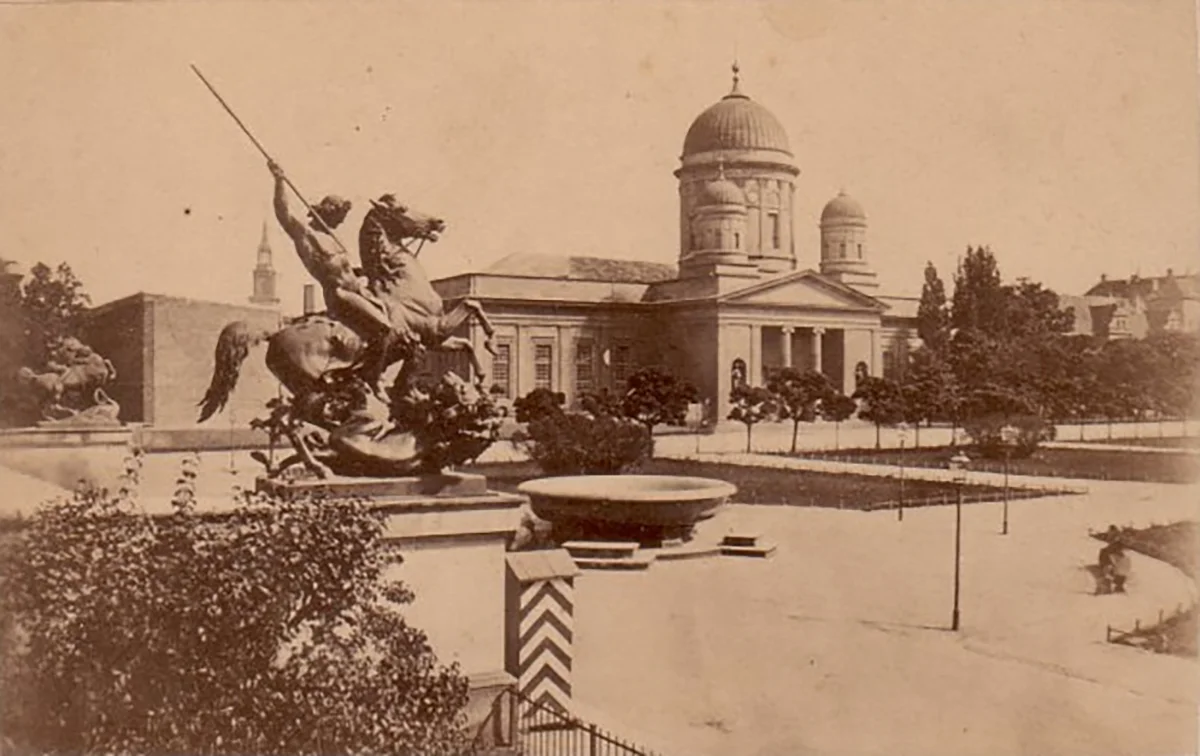
The “Advertising Emperor” eventually had the old cathedral demolished – he thought it was too small.


